Retention
The retention report shows how many of your users come back, week after week. Open Product analytics in a project’s menu, then the Retention tab.
Why retention counts signed-in users only
Section titled “Why retention counts signed-in users only”Ottertrail sets no cookies. It recognizes an anonymous visitor for one day only, so a visitor who comes back next week counts as a new visitor. Retention needs the same person across weeks, so it counts signed-in users only, by the ID that your app gives them.
Until your site names its signed-in users, the tab explains how: data-user-id on the script tag, and identify() when someone signs in without a page load. See Name signed-in users. Server-side events always carry a user ID, so they count too.
Read the table
Section titled “Read the table”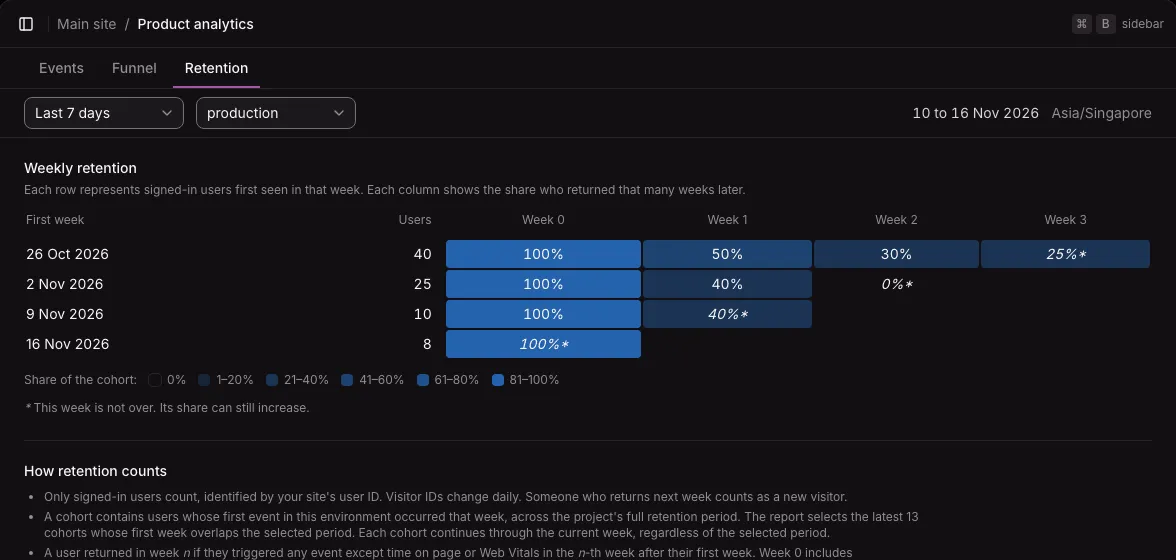
- Each row is a cohort: the signed-in users whose first event in this environment fell in that week. First week names the week by its Monday, and Users says how many users it holds.
- Each column is a week after it: Week 0 is the cohort’s own week, always 100%. Week 1 is the week after, and so on, up to 12 weeks.
- Each cell is the share of the cohort that came back in that week. Hover over it to see “x of y users”. The shade follows the legend under the table, “Share of the cohort”, and the number is always written.
- A share in italics with an asterisk is for the current week. It is not over, so its share can still increase.
A user came back in a week when they sent any event that week, except time on page and Web Vitals: a pageview, a custom event, an error, or a server-side event.
Details
Section titled “Details”- A user’s first event is looked for across all the events the project keeps, not only the period. So a cohort leaves out users who were seen before it, even long ago. When the project’s retention deletes a user’s first events, the user’s cohort can move later.
- The period picks which cohorts show: the latest 13 whose first week overlaps the period. Each cohort’s weeks run to the current week, whatever the period.
- Weeks start on Monday in the instance’s timezone.
- Events can arrive up to a day late, so a week’s shares can still increase for a day after it ends.
- The report counts one environment,
productionunless you choose another.
On a phone, the table scrolls sideways inside the page, with the First week column pinned.
Not available yet
Section titled “Not available yet”- Retention by a chosen event, instead of any event.
- Retention by day or by month.